Good morning from the snowy, icy, gross, streets of New York City.
This edition written with my design and creative subscribers in mind, so feel free to skip to the general links at the bottom if this isn't super relevant.
In a sentence, what I would like to say is this:
If you’re a designer who creates things for screens, you should be experimenting with Claude Code.
The tools designers have at our disposal to create our work have always changed and evolved as technology moves forward.
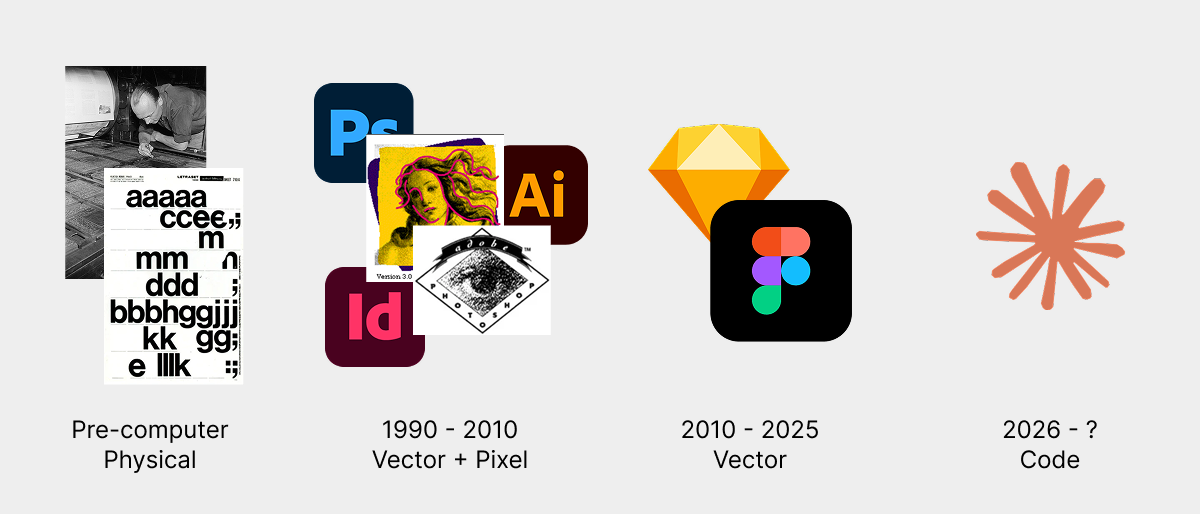
Our tools have shifted form physical metal type, to Letraset, to early versions of Illustrator and Photoshop.
Then as phones and laptops exploded into our lives we watched as those tools were repurposed for digital design and replaced by Sketch and Figma.
But, for a long as I have been working as a designer, my output has always been an abstraction of the finished product. A drawing of how I want the thing to look, feel and function.
A .pdf of a poster is close to the finished result, but it’s not until you see a proof printed on the uncoated stock you chose that you understand how the colours will really look.
You were always one step away from reality.
A Figma file of a website suffers from the same issue, but arguably worse. I want to text to sit in the center, but once in code, the text moves around on different screen sizes.
The inconsistencies that exist between what we design and what gets shipped to a screen lead to the “Should Designers Code” debate that kicked off years ago.
That was followed by the “Rise of the Design Engineer” (an in-demand creative who learned to both design and build their own front end code).
Both are conversations about closing the gap between what a designer wants on a screen and their ability to express it in higher fidelity.
I never learned to code in any meaningful way. But I have spend over 15 years designing for screens. I've always relied on talented and patient engineers (thank you Edward) to bring my ideas to life.
For most of January, I’ve been playing with Claude Code (more on that below).
Why I’m recommending you play with it, is that for the first time in my career, I have been able to produce working and moving interfaces that are much closer to the ideas I have in my head.
I am now working in the final medium of project, not an abstracted layer above.
Using plain english to describe UI and interactions is a big step forward. This existed over a year ago but it was sketchy to say the least. The improvements since then have been significant.
The output might not be 'production ready' code, but it's not far off (or so I'm told).
…
Claude Code is the hot tool right now. It will likely be replaced by something else or Figma will launch something similar. I’m agnostic on the actual tools themselves.
What is clear and what should matter, is that technology is now at a point where the gap between what you can imagine and what you can make yourself is closing rapidly.
And that is the point of all tools.
Below I have linked to the many articles people have written about ‘why’ Claude Code and ‘how’ to get set up.
If you have a new client website or app project that needs prototyping or an idea of your own you’ve been meaning to explore, give it a go and let me know how it goes.
Nick :)
And mix number 2 is below!