Green Squares
May 2026
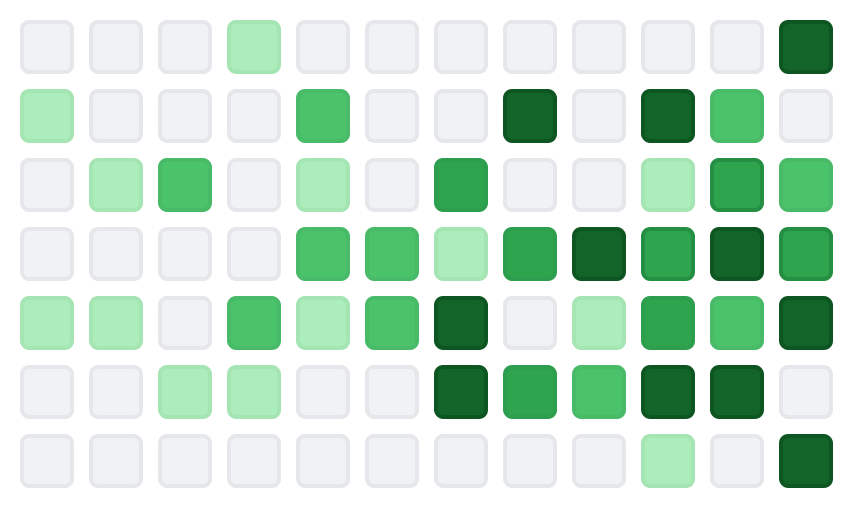
One way to think about design is that it is the process of experimenting and exploring ideas with tools and mediums that are not the same as what the finished product will be.
In almost every discipline I can think of, architecture, fashion, graphic, industrial, people start by sketching on paper or on a computer. The reason is obvious, speed. The cost of making changes to an idea on a screen is only your time.
And for the most part this works very well.
But I think it is true and should be a goal for designers everywhere, that on any given project, you should try to get your hands on the finished medium as soon as possible in the project.
I felt this deeply when we had our hardware start up. CAD renders felt entirely different as a 3d print and those felt entirely different from machined aluminium.
The gap between static, 2d version of your idea and the real thing is often wider than you think.
For many years now, designers have been laying out screens in Illustrator or Photoshop or Sketch or Figma. All of which, even when pixel perfect, are still just plans and directions for a developer to follow. They are by no means the finished product.
In the world of screens, we have canvases that move, change shape, lose connectivity, etc. In Figma, everything is perfectly static and set in stone.
A personal frustration in my career has always been that I have not had the development skills to bring my ideas directly to life on the screen. I've not been able to work in the same medium as the final product.
New AI tooling has changed this forever. I am now weeks into a new world where I am able to create pull requests and ship working interfaces with very little friction.
The feedback loop between what I can imagine and something that works is as short as it's ever been.
I know people are saying this a lot, but I really wouldn't hire anyone today who designs interfaces who isn't also in GitHub collecting green squares.